
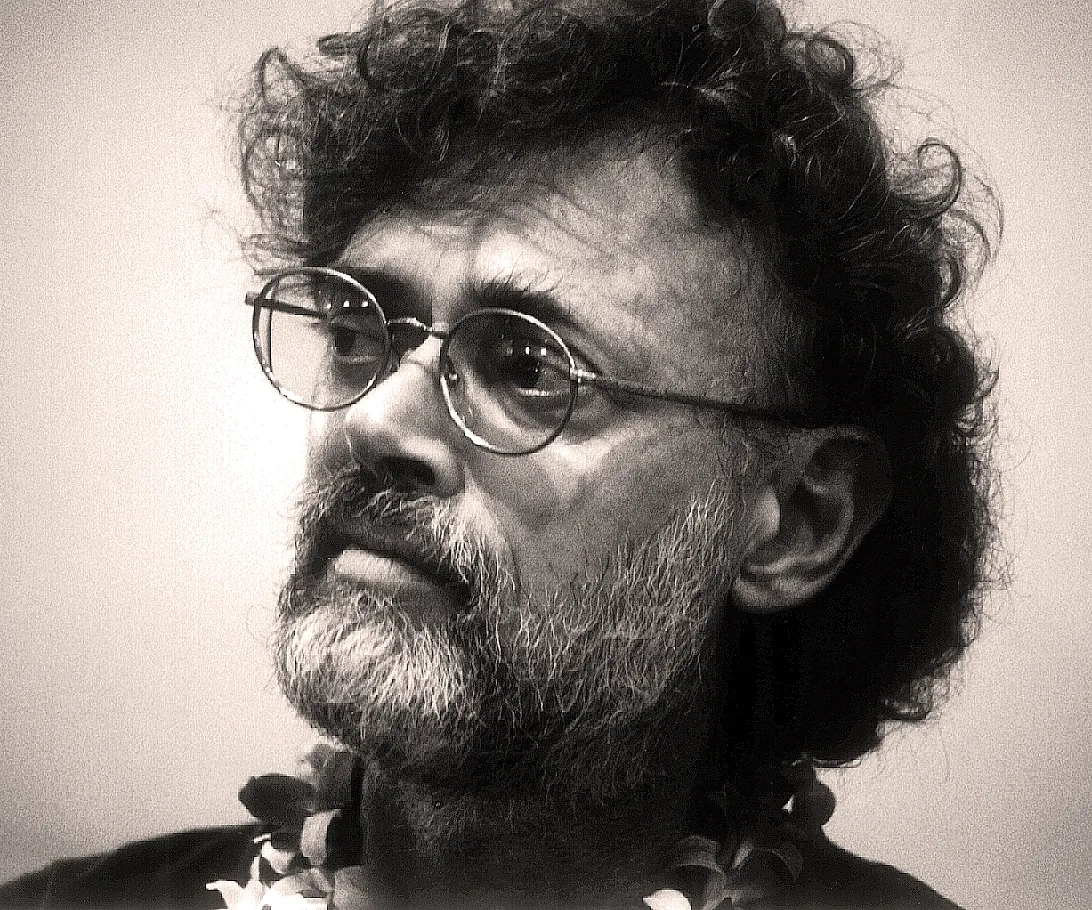
Anyone who digs into psychedelics runs into him sooner or later: in podcasts, in documentaries, in endlessly clipped lectures on YouTube with his nasal, hypnotic voice. More than twenty years after his death, Terence McKenna (1946–2000) is still the best-known voice of psychedelic culture. In this new series we portray the people who shaped how we think about psychedelics, honestly, which means including the parts of their story you should take with a grain of salt. We begin with the greatest storyteller of them all.
From bookworm to Amazon expedition
McKenna grew up in a small town in Colorado as a curious, somewhat unworldly child who collected fossils and devoured science fiction. Through the writer Aldous Huxley and the early psychedelic literature he became fascinated by consciousness as a teenager, and in the 1960s he studied at Berkeley, the epicenter of the counterculture, where he threw himself into ecology, shamanism and the role of plants in human cultures.
The formative moment came in 1971, when he traveled with his brother Dennis (who later became a respected ethnopharmacologist) to La Chorrera, deep in the Colombian Amazon. What began as a search for a traditional plant brew ended in weeks of experiments with psilocybin mushrooms, an episode so bizarre that Terence later wrote a whole book about it. The experiment produced no science, but it did produce the life mission of both brothers: one through the lab, the other through the stage.
Why people still listen to him
McKenna's lasting power lies not in his theories but in his language. He spoke about psychedelic experiences like no one before him: precise, witty and without embarrassment, as if he were reporting on a journey to a place that really exists. For a generation that grew up with 'drugs are bad' as the only message, here suddenly was someone who took the inside of the experience seriously and could put full sentences to it. On top of that he was an early and serious advocate of ethnobotany: together with his wife he founded an organization to preserve traditional plant knowledge and seeds from endangered cultures, work that continues to this day.
His best-known books, including his argument about the role of plants in human history and his memoir about La Chorrera, are still read, and his lectures have become a genre of their own online. McKenna died in 2000, at the age of 53, from an aggressive brain tumor; he remained the articulate storyteller he had always been right up to the end.
The ideas, and what science makes of them
An honest portrait was promised, so here it comes. McKenna's most famous hypothesis, the 'stoned ape' theory, holds that psilocybin mushrooms in the diet of early hominids drove the evolution of language and consciousness. It is a beautiful story, and it is rejected almost unanimously by evolutionary biologists and anthropologists as speculation without evidence. His 'Timewave Zero' theory, which predicted that history would rush toward a singular endpoint in 2012, has been refuted by 2013 in the most definitive way there is: the calendar.
Does that mean McKenna is worthless? No. It means you should read him as what he was: a philosophical storyteller and provocateur, not a scientist. Even his brother Dennis, who was a scientist, fondly describes Terence as someone who launched ideas the way others set off fireworks: dazzling to watch, not meant to build on.
The heroic dose: why we see it differently
Then the advice McKenna is quoted for most often: the 'heroic dose', five grams of dried mushrooms, alone, in silence and darkness. His reasoning: only at an overwhelming dose does the experience refuse to be rationalized away. What is worth knowing here: McKenna spoke from decades of experience, an exceptional familiarity with the material and a philosophical agenda. For almost everyone reading this, that advice is simply unwise, an overwhelming experience without a foundation built up over time is exactly how difficult trips happen.
Our approach deliberately runs counter to it: start low, get to know yourself and build up step by step, with attention to set and setting. Not because deep experiences can't have value, but because the path toward them ought to be gradual. McKenna himself would no doubt come back with something eloquent, but then again he didn't have to carry any responsibility for your first time.
Why this portrait belongs in this series
McKenna teaches you two things at once. That language and imagination matter: how we talk about these experiences shapes how we live through them. And that charisma is not proof: the finest storyteller in psychedelic history was regularly, spectacularly wrong. Anyone who takes both lessons on board is a wiser psychonaut than someone who believes only one. In the next installment of this series: Timothy Leary, the Harvard psychologist who turned psychedelics into a culture war.